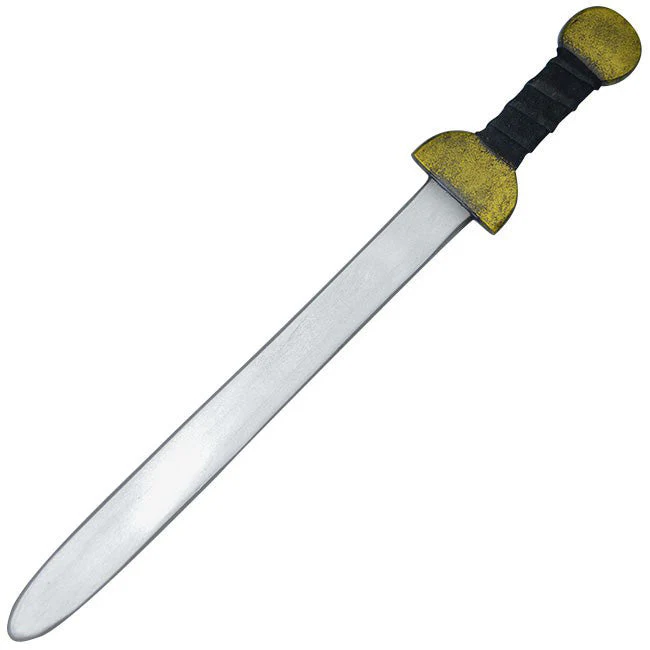

Three Lobe Viking Sword
The 3 Lobe Viking Sword is based on a late Viking design from around the 11th century and is contemporary with the Battle of Stamford Bridge in 1066. A similar sword was found on Canwick Common in Norfolk and is now held in the British Museum collection.
It features a forged and fullered steel blade designed for hacking and slashing and is hilted with a short guard and 3 lobed pommel. The wooden scabbard is wrapped with brown leather to match that of the leather wrapped sword grip. Although this sword has a forged blade it is not tempered and is not suitable for combat.
Total length: 95cm
Blade length: 79cm
Grip length: 10.5cm
Weight: 1352g
Blade thickness (base): 0.6cm
Blade width (base): 4.4cm
Point of Balance (PoB): 17cm
Blade: EN45 High Carbon Steel
Edge: Blunt
Pommel: Peened
Scabbard: Wood, Leather
All dimensions are approximate and may vary from piece to piece.
This product is suitable for:
Display
Living History
Product Information
Product Information
Shipping & Returns
Shipping & Returns
Description
The 3 Lobe Viking Sword is based on a late Viking design from around the 11th century and is contemporary with the Battle of Stamford Bridge in 1066. A similar sword was found on Canwick Common in Norfolk and is now held in the British Museum collection.
It features a forged and fullered steel blade designed for hacking and slashing and is hilted with a short guard and 3 lobed pommel. The wooden scabbard is wrapped with brown leather to match that of the leather wrapped sword grip. Although this sword has a forged blade it is not tempered and is not suitable for combat.
Total length: 95cm
Blade length: 79cm
Grip length: 10.5cm
Weight: 1352g
Blade thickness (base): 0.6cm
Blade width (base): 4.4cm
Point of Balance (PoB): 17cm
Blade: EN45 High Carbon Steel
Edge: Blunt
Pommel: Peened
Scabbard: Wood, Leather
All dimensions are approximate and may vary from piece to piece.
This product is suitable for:
Display
Living History